Salary vs Dividends 2026/27: What’s the Most Tax-Efficient Way to Pay Yourself?
If you’re a limited company director, one of the biggest financial decisions you’ll make each year is how to pay yourself.
Should you take a salary, dividends, or a combination of both?
For many years, the answer was relatively straightforward. A low salary topped up with dividends was often the most tax-efficient approach. However, changes to Corporation Tax, Dividend Tax and National Insurance mean that the best salary vs dividends strategy for 2026/27 is no longer the same for every director.
The right answer depends on your company, your personal circumstances and your future plans.

Why Salary vs Dividends Matters
Choosing the right balance between salary and dividends can significantly affect:
Your Income Tax
Corporation Tax
Dividend Tax
Employer’s National Insurance
Employee’s National Insurance
Your State Pension entitlement
Your long-term retirement planning
Rather than looking at each tax individually, it’s important to understand how they work together to create the most tax-efficient remuneration strategy.
There Is No One-Size-Fits-All Answer
Many directors still rely on advice they received several years ago.
Unfortunately, tax legislation changes almost every year, meaning a strategy that previously saved tax could now cost you more than necessary.
When reviewing the most tax-efficient salary for directors, we consider:
Expected company profits
Your required personal income
Whether your company qualifies for the Employment Allowance
Existing salary, dividends and other taxable income
Pension contributions
Planned business investment
Retirement objectives
Future business growth
Every business is different, which is why professional remuneration planning can often produce significantly better results than relying on generic online advice.
Salary vs Dividends 2026/27 Planning Guide
To make the decision easier, we’ve developed our Salary vs Dividends Planning Guide for the 2026/27 tax year.
Using your expected company profit alongside the income you wish to receive personally, the guide highlights where taking:
All dividends
Mostly dividends
A mixed salary and dividend strategy
A higher salary
is likely to produce the best overall outcome.
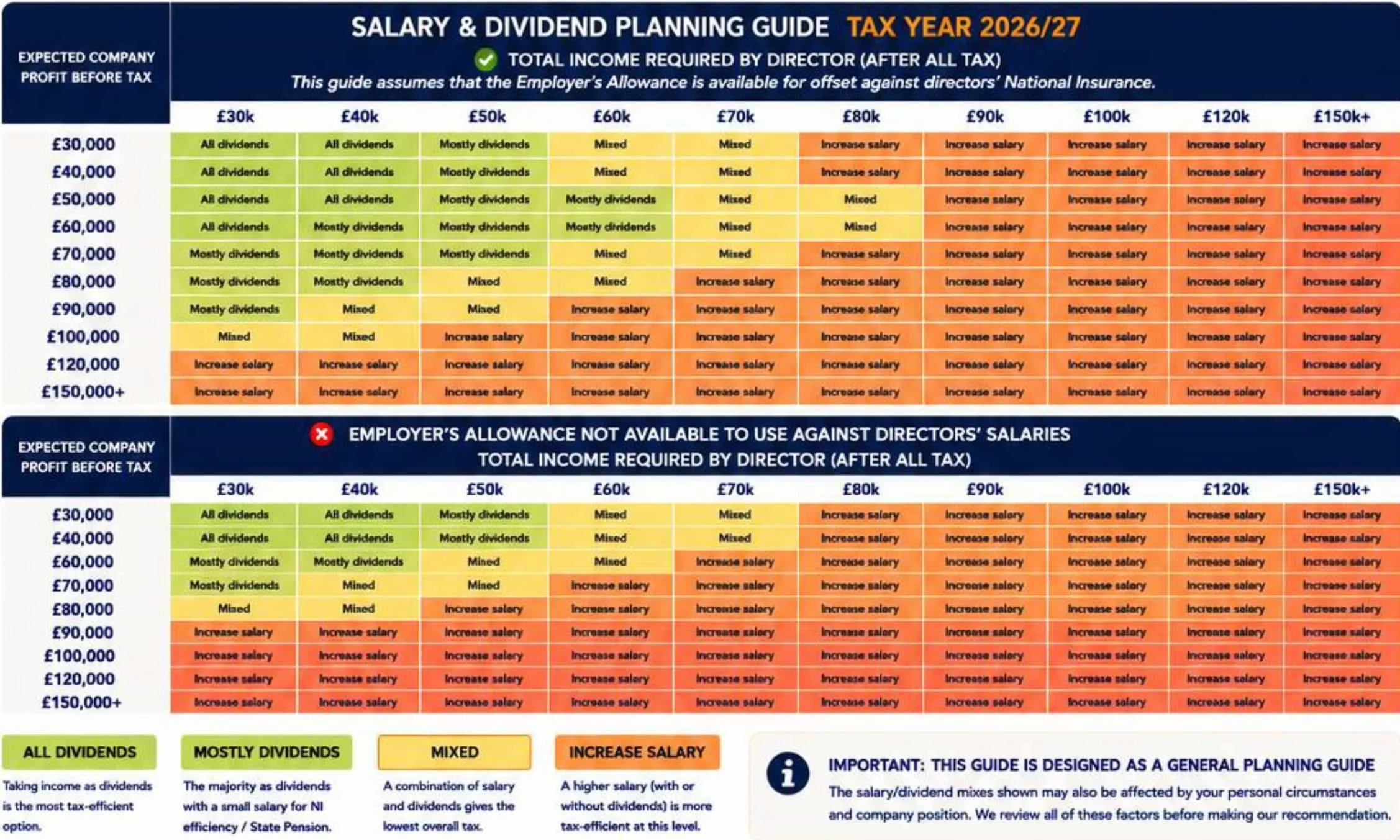
The guide (above) should be viewed as a planning tool rather than a fixed recommendation. Individual tax planning should always take your personal and business circumstances into account.
Why Annual Reviews Matter
The most tax-efficient salary and dividend strategy today may not be the right one next year.
Changes in profits, tax legislation or your personal circumstances can all affect the optimal balance.
That’s why we review our clients’ remuneration annually using the latest tax rules and financial information, ensuring they continue to maximise their take-home income while remaining fully compliant.
Could You Be Paying More Tax Than Necessary?
Many company directors continue to pay themselves the same way every year without checking whether their remuneration remains tax-efficient.
A simple review can often identify opportunities to reduce tax, improve cash flow and better align your income with your long-term financial goals.
If you’re unsure whether your current salary and dividend strategy is still working for you, we’d be delighted to help.
Our Salary vs Dividends Planning Review provides tailored advice based on your company profits, personal income requirements and the latest 2026/27 tax legislation.
Speak to Accounts Action
Whether you’re a sole director or run a growing limited company, choosing the right salary and dividend mix could save you thousands over time.
Contact Accounts Action today to arrange a personalised Salary vs Dividends review and discover the most tax-efficient way to pay yourself in 2026/27.